Advertising helps fund Big Issue’s mission to end poverty
Opinion

This Lancaster Priory monument was a culture wars flashpoint. Then it became a force for good

Rather than removing a contested monument, civic institutions are contextualising it within a broader story that includes voices once excluded from public memory

The monument at Lancaster Priory.

The monument at Lancaster Priory. Image: Supplied

Lancaster is a pretty tranquil place. Set on the river Lune and within sight of the Lakeland fells, it can feel far removed from the culture wars dominating Westminster and social media. Look closer, though, and you’ll find signs of the same tensions. A dispute over local history, identity and belonging is playing out here silently in spray paint and stone.

Five years ago, the National Trust’s report on its historical links with colonialism and slavery sparked a nationwide re-examination of Britain’s past. In Lancaster, that wider reckoning prompted many people to lift the veil on aspects of the city’s history that lay hidden in plain sight.

Lancaster was the fourth most active British port involved in the transatlantic slave trade. Well over 100 ships set sail from here bound for west Africa during the 1700s. The wealth that brought Lancaster is still evident today, especially along St George’s Quay. Buildings like the Customs House (designed in 1764) were built on the back of commerce that dehumanised and trafficked thousands of enslaved Africans.

Read more:

This difficult part of Lancaster’s history has been examined by local historians and academics. Until recently, though, it was little acknowledged. That began to change in earnest after the global Black Lives Matter movement in 2020 refocused attention on Britain’s role in historical colonialism and slavery.

That spring, the Rawlinson and Lindow monument at Lancaster Priory became a flashpoint in local debates about memory, history and identity. The Rawlinsons and Lindows were both prominent local families whose wealth was tied to the slave trade, and their monument stood in the priory churchyard for generations, largely unremarked. That changed in 2020, when someone spray-painted ‘slave trader’ across the stone.
Advertising helps fund Big Issue’s mission to end poverty
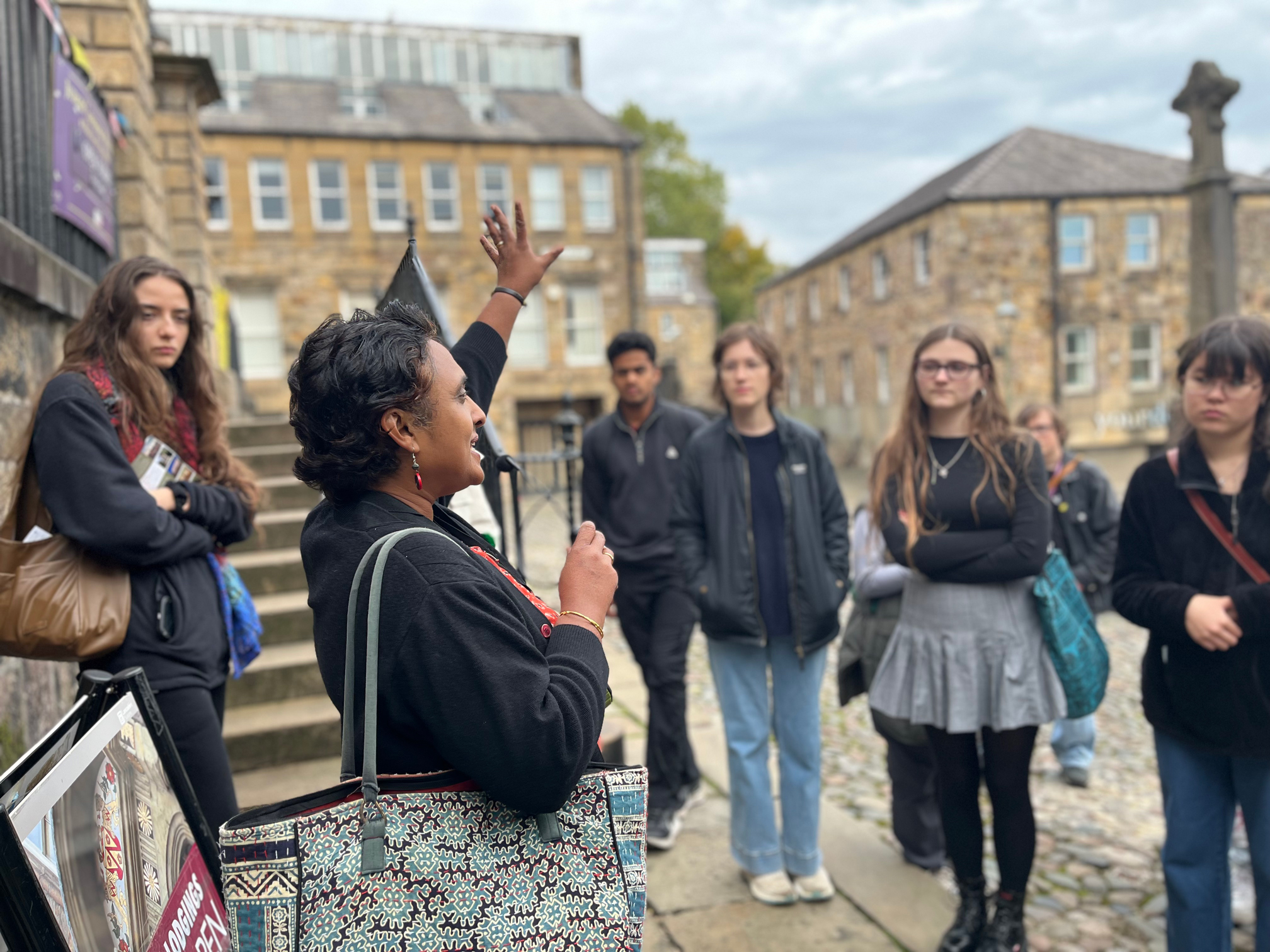
People are now learning about the true history of Lancaster. Image: Supplied

The church chose not to remove the graffiti immediately, viewing it instead as a prompt to reflect on a difficult chapter in Lancaster’s past. As the area Dean put it, they sought to hold “space for both sorrow and truth”, acknowledging historical injustices while informing visitors about the story behind the stone.

The Priory went on to hold a series of public events in collaboration with other local groups to examine ways forward in relation to building awareness and challenging existing ‘sanitised’ narratives. The Facing the Past project has helped open up spaces for discussion, reflection and debate.

The tensions didn’t stop there, though. The monument was defaced again just this past August. Overnight someone sprayed a red cross on its northern and southern sides. That same cross, St George’s Cross, was popping up in other public spaces around the city as well as in other parts of the country. This was often in lockstep with movements some see as a backlash against efforts to address Britain’s imperial past.

This local incident mirrors national debates. Across the United Kingdom, monuments to historical figures with ties to slavery have become battlegrounds. Take Bristol, where the statue of Edward Colston was toppled in 2020 and later displayed in a museum, reframed as an artefact rather than a civic tribute.

Lancaster’s approach has been different. Rather than removing a contested monument, civic institutions are trying to contextualise and reframe one within a broader story that includes voices once excluded from public memory.

Monuments can spark change. Image: Supplied

Around the city, efforts to tell this fuller history find precedent in Kevin Dalton Johnson’s Captured Africans sculpture on St George’s Quay. Commissioned in 2005 as part of a Slave Trade Art Memorial project, the work was restored in 2025 and stands as a reminder of the human cost of slavery. As Britain’s first quayside memorial to enslaved Africans, it is a site that encourages dialogue not dogma.

Locals and visitors can now engage in such dialogue in many ways. There are trails and exhibitions that trace the city’s involvement in in transatlantic slavery. Community research projects like Slavery Family Trees and Facing the Past are highlighting Black agency, building digital archives and disseminating findings through grassroots collaboration.

These efforts have not always been smooth. Some residents resist what they see as an importation of culture-wars language into local life. Some argue that too much emphasis on past wrongs denigrates civic pride. Others worry that acknowledging uncomfortable histories will lead to erasure rather than understanding. Yet for many, confronting that past is the only way to build a more equitable future.

In this, Lancaster’s situation mirrors a broader national moment. The National Trust’s report was not the end of Britain’s conversation about its history. It was a new chapter, one that challenged institutions and communities to rethink what is commemorated and why.

The graffiti on the Rawlinson and Lindow monument reminds us that learning from the past and building an equitable present remain unfinished tasks. To confront historical colonialism and slavery, we must move beyond symbolism and reclaim memorials as spaces for dialogue, learning and reflection.

Dr Chris Donaldson specialises in the regional history of north-west England. Dr Sunita Abraham works on themes associated with decolonisation, anti-racism and migration.

Do you have a story to tell or opinions to share about this? Get in touch and tell us more

Change a vendor’s life this Christmas.

Buy from your local Big Issue vendor every week – or support online with a vendor support kit or a subscription – and help people work their way out of poverty with dignity.

Advertising helps fund Big Issue’s mission to end poverty

GIVE A GIFT THAT CHANGES A VENDOR'S LIFE THIS CHRISTMAS 🎁

For £36.99, help a vendor stay warm, earn an extra £520, and build a better future.
Grant, vendor

Recommended for you

View all
Labour's veterans minister: How we're tackling the 'national shame' of veteran homelessness
Louise Sandher-Jones

Labour's veterans minister: How we're tackling the 'national shame' of veteran homelessness

No room at the inn for refugees? Many Brits are happy to welcome strangers in need
Dr Krish Kandiah

No room at the inn for refugees? Many Brits are happy to welcome strangers in need

I dreaded turning 18 as a care leaver. There is a cliff-edge which leaves us without support
Alfie-James Waring
Alfie-James Waring

I dreaded turning 18 as a care leaver. There is a cliff-edge which leaves us without support

Labour's immigration shake-up is like the hostile environment on steroids
National Demonstration for Migrant Workers’ Rights protest in Birmingham
Munya Radzi

Labour's immigration shake-up is like the hostile environment on steroids