Advertising helps fund Big Issue’s mission to end poverty
Opinion

House of Campaigns: We need to open parliament up to campaigners to give us the voice we deserve

A House of Campaigns could make campaigners feel that they have a genuine presence in Westminster

The House of Commons

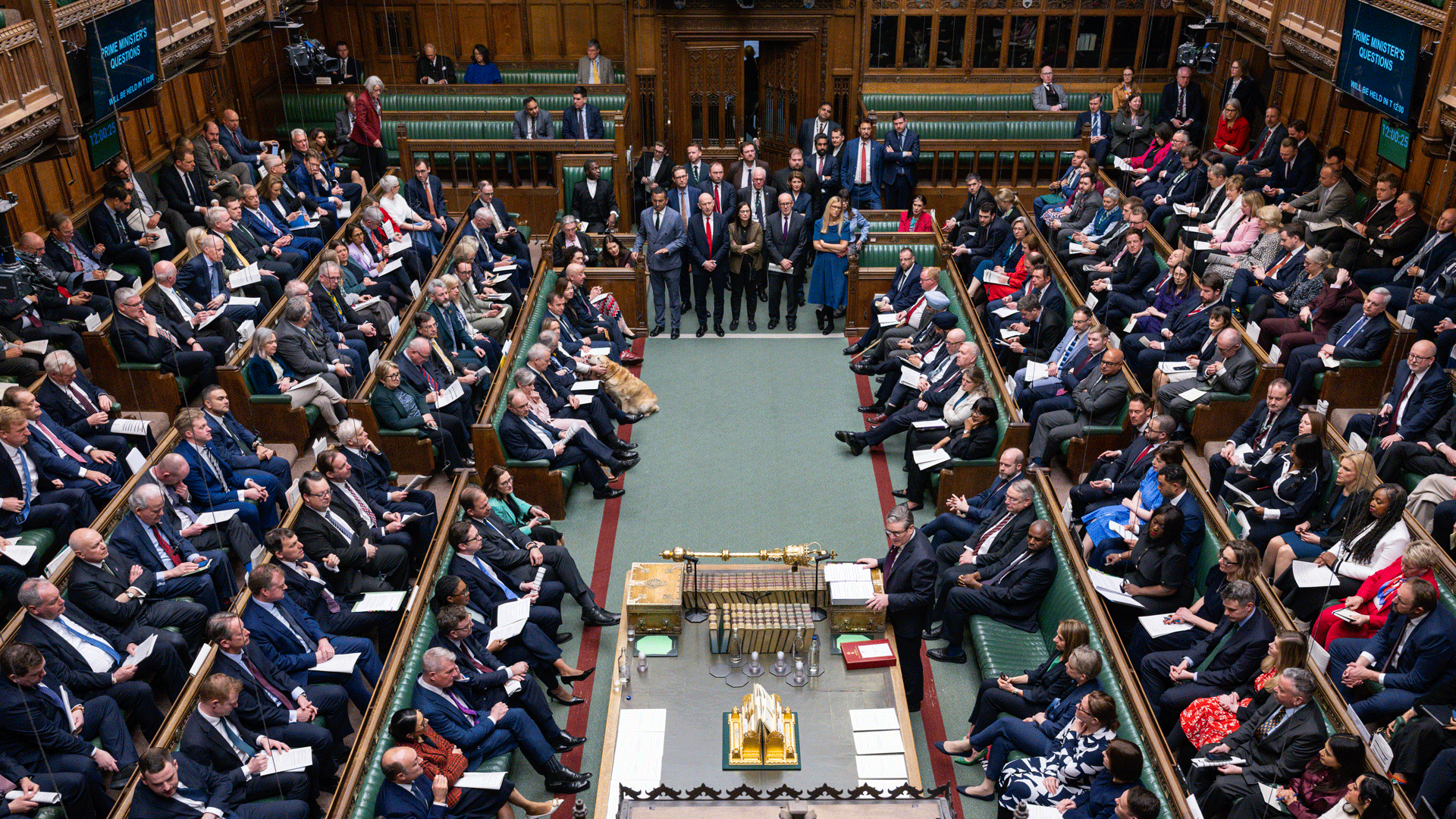
The House of commons Chamber during PMQs, 18 March. Image: ©House of Commons / Flickr

Last September, we launched our plan for a House of Campaigns. This is a new chamber in parliament that would give representative and campaigning groups a bespoke presence in Westminster.  

Despite the huge number of people who join and support Britain’s campaigning organisations, they often struggle to win the hearing that they deserve. 

At present, voices can be raised and issues put in front of decision makers through the parliamentary e-petition system. If an e-petition receives more than 100,000 signatures it will be considered for debate in the House of Commons. In the 10 years since the parliamentary e-petitions website was launched, 382 such debates have taken place. These debates can be a useful way to put pressure on the government. A small number of e-petitions have even led to changes in the law.

Get the latest news and insight into how the Big Issue magazine is made by signing up for the Inside Big Issue newsletter

Many more, however, sink without trace. There have also been some flippant petitions that undermine the credibility of the system itself. As we pointed out when we launched, the fact that MPs have not chosen to debate the subject matter of a given e-petition means that parliamentarians may not be familiar with the issue and may not be able to present the arguments in the most powerful way. It would often be better to allow campaigners to make their own case, in their own words. That would be the next logical step for the e-petition system. 

The current petition system was never intended to be the end point. When he introduced the reform that allowed for petitions to be debated by MPs, Sir George Young (then the leader of the House of Commons and now championing participatory democracy from the House of Lords) said that this reform was “a step towards a more accessible and transparent” parliament. At the same time, however, he warned against the danger of parliament becoming “complacent”. 

Advertising helps fund Big Issue’s mission to end poverty

Read more:

He was right on both counts. Bringing campaigns into parliament was an important step forward. It is now time to take another step and to bring campaigners themselves into parliament. 

To recap what we’re proposing: The House of Campaigns would not have a permanent membership but rather would be open to Britain’s campaigning organisations. It would meet on one Friday each month, in Westminster. We propose six 30-minute sessions per day, which immediately factors up the opportunity for campaigns to be heard. Campaigns wanting to speak in the chamber would apply online. The sessions would be allocated by a House of Campaigns Committee made up of representatives from across the political spectrum. 

Each hearing would conclude with a Request for Action asking a government department to take a specific action. The government would not be obliged to comply with the Request for Action but would be obliged to respond in detail. If the government decided not to act, it would need to then explain its decision. The House of Campaigns would give campaigners direct access to ministers and it would ensure that those ministers paid attention. That is far more than many campaigners get at present. 

Importantly, the new House could also put campaigns on the national news agenda. By meeting on Fridays, when the House of Commons and the Lords rarely sit, the House of Campaigns would secure a monopoly on parliamentary reporting. This should enable the campaigns to attract some media attention and to win public support for their causes. 

Various campaigns have pledged support. These include EcoCounts (an environmental advocacy organisation), Campaign Collective (a strategic communications/advice social enterprise) and Rebecca Baron (a social impact consultant). Tellingly, one of the leading individual campaigners to give the idea her backing is Jo Hamilton OBE, a leader of the subpostmasters’ campaign. We all know how vital and impactful that campaign was. It’s an inspiration.

“Having shouted at the Westminster machine for nearly two decades, change can’t come soon enough,” said Hamilton. “The only thing that made government listen to us was the brilliant ITV drama and the public reaction. I fully support a House of Campaigns.”

Attempts at parliamentary reform often fail for lack of popular interest. In this case, however, if supportive campaigning organisations can mobilise their supporters, as well as their media and political contacts, then momentum could build quickly. We are finalising a policy paper that will detail our position further. We are seeking people to help fine-tune the proposal and to be part of the change. If you would like to be involved, or if you would like to encourage a campaign that you support to take part, we want to hear from you. Campaigns are fundamental to the way in which most of us engage with politics. It is time for a
House of Campaigns.

Richard Ellis is coordinating efforts to promote the House of Campaigns. Email him if you would like to be involved.

Do you have a story to tell or opinions to share about this? Get in touch and tell us more

Change a vendor’s life.

Buy from your local Big Issue vendor every week – and always take the magazine. It’s how vendors earn with dignity and move forward.

You can also support online:
Subscribe to the magazine or support our work with a monthly gift. Your support helps vendors earn, learn and thrive while strengthening our frontline services.

Thank you for standing with Big Issue vendors.

Advertising helps fund Big Issue’s mission to end poverty

DO YOU KNOW HOW BIG ISSUE 'REALLY' WORKS?

Watch this simple explanation.

Recommended for you

View all
Why are homeless people being excluded from social housing? There has to be a better way
Social housing
Francesca Albanese

Why are homeless people being excluded from social housing? There has to be a better way

Birmingham bin workers' strike shows essential workers deserve support – and a decent wage
John Bird

Birmingham bin workers' strike shows essential workers deserve support – and a decent wage

Retrofit or regret: Why the fastest way to reach net zero is to fix what we already have
Eugene Clarke

Retrofit or regret: Why the fastest way to reach net zero is to fix what we already have

Labour wants to cut benefit spending. Here's how giving people free cash could save money instead
Prime minister Keir Starmer and chancellor Rachel Reeves.
Professor Michael Sanders

Labour wants to cut benefit spending. Here's how giving people free cash could save money instead